Why AI Adoption Fails the Same Way Agile Did
I have been watching companies try to adopt AI agents for a little over a year now. And I keep seeing the same story. It reminds me of something that happened before, about ten years ago, when companies were trying to adopt agile. Many of them failed. Not because agile was a bad idea. They failed because they did not understand what adoption really means.
Let me explain what I mean.
The agile lesson nobody learned
When companies started adopting agile, the common mistake was treating it like a new tool you plug into an old system. A research study from Harvard Business Review looked at agile transformations across scores of companies. The researchers found that nearly 90% of them struggled when they tried to scale agile across the whole organization. The problem was not the methodology. The problem was culture and mindset.
ING bank in the Netherlands is one of the most honest examples of this. When they went agile, they did not just change their process. They restructured the whole organization. About one third of their senior managers left. People had to reapply for new roles. It was painful. But it worked because they accepted the real change that agile requires, which is a shift in power, in thinking, and in how people work together.
As Bart Schlatmann, COO of ING Netherlands at the time, said about the transformation: "It requires sacrifices and a willingness to give up fundamental parts of your current way of working."
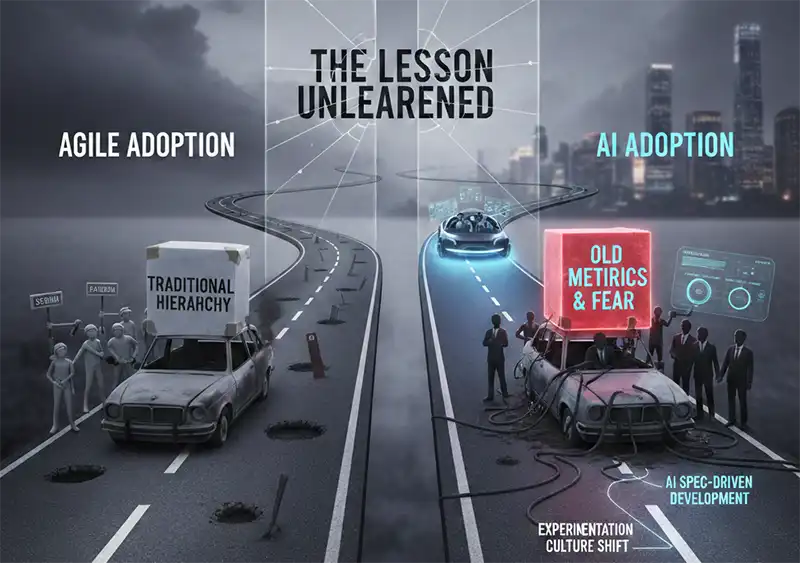
Most companies were not ready for that. They adopted the ceremonies, the sprints, the standups. But they kept the old hierarchy, the old control, the old metrics. They put agile on top of the same culture and wondered why it did not work.
AI adoption is following the same path
Today I see the exact same pattern with AI. Companies are adding AI tools on top of the same old processes. They use AI to generate code faster, to summarize documents, to write tickets. These are useful things. But they are not transformation. They are optimization. There is a big difference.
According to MIT Sloan Management Review, AI is already moving through three stages across industries. First it assists, then it reshapes, and finally it replaces certain tasks. Software development is already deep into stage two. The role of an engineer is being reshaped right now. But most companies are still asking the same questions they asked before AI. How long will this task take? How do we measure developer productivity? How many story points can the team deliver?
These questions are wrong. They were wrong before AI too. The right question is how does this work change the business outcome. Not how many lines of code were written or how fast a ticket was closed.
Fear is blocking real change
There is another force at work here. People are afraid. Engineers are afraid of losing their jobs. Managers are afraid of losing control. This is understandable. When ING adopted agile, many people left the company. When AI enters the picture, the same thing happens. Some roles become smaller. Some processes stop making sense.
A 2023 survey found that more than half of people using AI at work were doing it without telling their managers. They were afraid of what would happen if they did. This is not a technology problem. This is a culture problem. Companies that want real AI adoption need to make it safe for people to experiment, to talk openly about what AI can and cannot do, and to change how they work without being punished for it.
The only way that actually works
In my team we spent six or seven months trying different tools and approaches before we found something that actually worked. We tested a lot of things. Most of them did not fit. Slowly we built what I now call AI spec-driven development, an approach where we write detailed specifications for AI agents that cover the full development lifecycle, from understanding the business requirement all the way to testing and delivery.
Today we write 100% of our production code this way. We stopped writing code by hand. We also started automating more and more parts of our workflow with AI agents. Not just coding, but testing, documentation, and routine decisions that used to take time away from real thinking.
What changed most is the role of the engineer. Today the work looks like this. You write a spec together with an agent. You launch the agent. You wait. Then you verify the result in the real world. That is it. The engineer is no longer present during execution. They are present at two moments that still require a human: forming the intent at the beginning and taking responsibility for the outcome at the end.
But this also revealed a new problem. Agents work faster every month. The bottleneck is no longer execution. It is spec production. Engineers are the slow part now. Context switching between parallel agents running at the same time creates cognitive load that is hard to manage. And we learned that the quality of the spec matters more than the speed of writing it. A good spec does not just describe what to build. It explains why certain decisions were made. When the agent understands the reasoning behind a decision, it handles ambiguity on its own instead of stopping and waiting for the engineer.
Getting here took months of real work inside the team. Nobody could have told us how to do this from the outside. We had to learn it ourselves. This is the key insight. Real AI adoption does not come from the top down. It does not come from a strategy document or a consulting report. It comes from teams who use AI every day and slowly understand what works and what does not.
Ethan Mollick from Wharton School wrote exactly this in MIT Sloan Management Review. He said that only work teams can figure out how to use AI to actually get work done and that teams need to develop their own methods through experimentation.
What this means for leaders
If you are leading an R&D team right now, the worst thing you can do is wait for clarity from above. The second worst thing is to measure AI adoption with the same metrics you used before. Ask instead where your teams are already using AI on their own. Give them room to experiment. Let them share what they learn.
Agile taught us that you cannot change how people work without changing how they think. AI is teaching us the same lesson again. The companies that learn it this time will not need to learn it a third time.
Comments