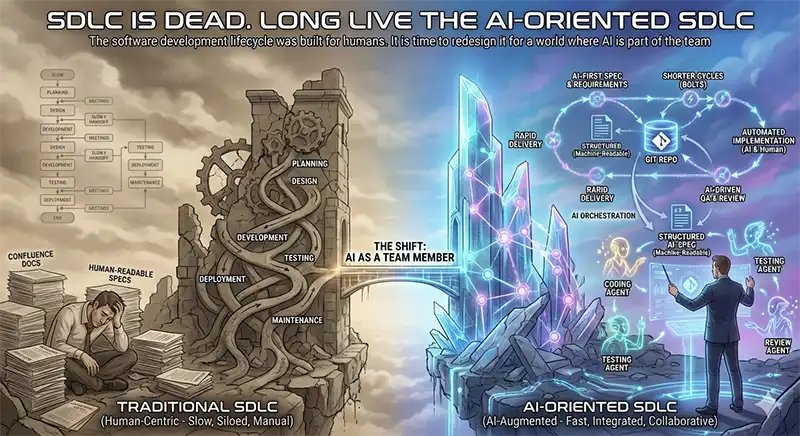
SDLC Is Dead. Long Live the AI-Oriented SDLC.
For decades, the Software Development Lifecycle (SDLC) has been our main framework for building software. We all know the steps. Planning, design, development, testing, deployment, maintenance. Agile, Scrum, DevOps. Each methodology tried to make these steps faster and better. But they all share one thing. They were designed for humans.
Every role, every process, every meeting was built around how people work. People get tired. People need context switching time. People need meetings to align. We break big tasks into small ones because humans work better that way. We write documentation so other humans can understand our decisions. We have code reviews because humans make mistakes. The whole system is shaped by human strengths and human limitations.
But what happens when AI joins the team? Not as a fancy autocomplete, but as a real participant in the development process?
The shift is already happening
AI coding agents like GitHub Copilot, Claude Code, Cursor, and others are not just tools anymore. They write code, generate tests, review pull requests, and create documentation. According to Gartner, by 2028, 90% of enterprise software engineers will use AI code assistants. That is up from less than 14% in early 2024. That is a massive change.
And it is not just about coding. McKinsey's 2025 State of AI report shows that nearly 9 out of 10 organizations now regularly use AI. AWS has even introduced a new concept called AI-DLC (AI-Driven Development Lifecycle). It is a methodology built from scratch around AI capabilities, not just adding AI on top of old processes.
The message is clear. We cannot just put AI into our old SDLC and hope for the best. We need to rethink the whole approach.
Documentation is no longer just for humans
Here is a simple example. In the traditional SDLC, we write documentation for people. Product requirements, technical specs, architecture decisions. We use natural language, diagrams, and presentations.
But now, documentation needs to serve AI agents too. AI agents work better with structured, clear, and machine-readable specs. GitHub released an open-source tool called Spec Kit that puts specifications at the center of the engineering process. Both humans and AI agents can use it.
This is a big mindset shift. When I write a technical spec today, I think about two audiences. My team and the AI agent that will work on the implementation.
How we do it in my team
In my team, we already work this way. We follow an AI spec-driven development approach. For every feature or task, we write a specification that is designed for the AI agent first. This spec includes everything in one document. Development requirements, testing criteria, and delivery steps. There are no separate documents for each stage. One spec covers the full lifecycle.
We also moved away from storing documentation in Confluence. Instead, all our specs live in the Git repository, right next to the code. Why? Because AI agents work with code repositories. When the spec is in the same place as the code, the AI agent has direct access to all the context it needs.
These specs are still readable by humans. Any engineer on the team can open them and understand the plan. But the main goal is different now. The spec is a clear guide and work plan for the AI agent. It tells the agent what to build, how to test it, and how to deliver it. The clearer and more structured the spec is, the better the AI agent performs.
This approach changed how my engineers work. They spend more time thinking about the problem, writing good specs, and reviewing AI output. They spend less time on routine coding and manual testing. The result is faster delivery and better quality.
Team roles are changing
When AI can generate code, write tests, and even do code reviews, what happens to the team? Gartner says it clearly. The developer role will shift from implementation to orchestration. Developers will focus more on problem-solving, system design, and making sure AI delivers quality results.
Tasks that we used to split between several people can now often be handled in one flow with AI assistance. Writing code, writing tests, writing documentation. All of that can happen together. The boundaries between roles become less strict. A developer with AI support can do things that previously needed a separate QA engineer or technical writer.
This does not mean we need fewer people. It means people do different things. We need engineers who can work with AI agents effectively, who can review AI output critically, and who can design systems that AI agents can work with.
What the AI-oriented SDLC looks like
I believe the new SDLC will have these key differences.
AI-first documentation. Specs and requirements are structured so both humans and AI agents can use them but optimized for AI first. Documentation lives with the code, not in a separate knowledge base.
Shorter cycles. AWS calls them "bolts" instead of sprints. Work cycles measured in hours or days, not weeks. When AI handles the heavy lifting of implementation, iteration speed goes up dramatically.
Fewer handoffs. Many tasks that required separate roles and handoffs can now be combined into a single spec and a single flow. One person with AI support can move from requirement to code to test to delivery much faster.
New quality processes. AI-generated code needs new kinds of review. The Qodo 2025 report showed that AI code reviews improved quality to 81%, up from 55%. But we still need human judgment for architecture decisions and business logic.
The bottom line
The traditional SDLC served us well for many years. But it was built for a world where only humans did the work. That world is changing fast. Gartner's survey of 700+ CIOs found that by 2030, zero percent of IT work will be done by humans without AI. 75% will be humans augmented with AI, and 25% will be done by AI alone.
We do not need to throw away everything we know. But we do need to redesign our processes, our documentation, and our team structures for a reality where AI is not just a helper. It is a team member.
The SDLC is dead. Long live the AI-oriented SDLC.
Comments