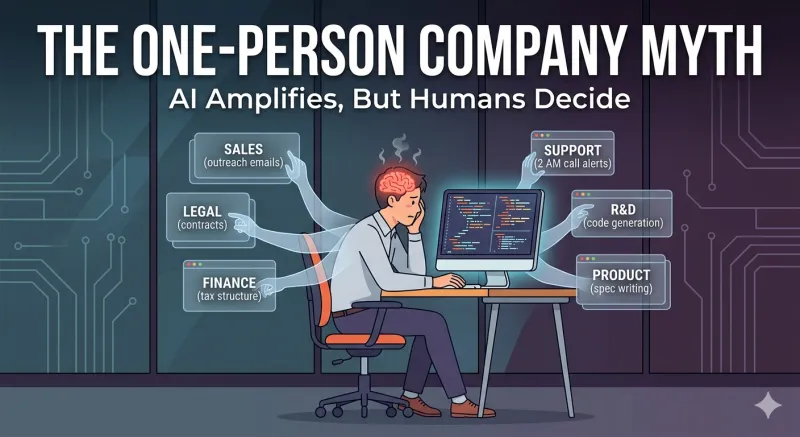
The One-Person Company Myth. What I See From Inside
Sam Altman said in public a while back that his group chat of tech CEOs runs a betting pool on the year somebody builds a one-person billion-dollar company, and Dario Amodei at Anthropic put the odds at 70 to 80 percent for 2026. A few weeks ago a founder named Matthew Gallagher got press for building a telehealth unicorn almost alone with AI running most of the business, until reporters noticed he relies on contractors across sales and operations, but the story is already everywhere on LinkedIn anyway.
I want to believe all of this, honestly, because it would make a great narrative for our industry and would flatter everyone in it including me. But when I check what I see from where I sit every day, running an R&D team at one company and being a co-founder at another, the picture looks more complicated than the pitch.
Two chairs, one view
My main job is Head of Software Engineering at Gatewise, which is now part of Allegion after the acquisition closed last year. On the side I am also technical co-founder at MyTruckAI, a logistics startup we are rolling out right now, plus one more early stage project that is too raw to name publicly. Three different companies at different stages, and yet all of them keep pushing me toward the same observation.
At Gatewise my team spent about a year rebuilding how R&D works around AI agents, moving documentation from Confluence into Git, cutting roles and processes that made sense when humans wrote every line, and landing on a methodology we call AI spec-driven development where we write 100 percent of production code through AI agents. A typical project now runs with two or three people total, engineers own the full cycle from spec to production, and product owners step in only at the edges. The setup runs better than the old one, productivity is up and the team is happier than a year ago. This is the lean AI team story you read on LinkedIn these days, and from running it every day I can tell you it works.
What the press does not mention
Even with all this going well, my engineers at Gatewise cannot also run sales, handle customer support escalations when something breaks at two in the morning, or deal with the commercial paperwork for a new partnership. Not because they lack intelligence, my engineers are some of the smartest people I have worked with, but because they do not have the domain knowledge for the commercial side and would not have the hours in a week to both do their current job well and grow a second discipline on the side even with AI helping them. Remember, this is a company where all those other functions already exist around the engineering team, sales, legal, finance, people operations, a whole support system holding the other end of the rope. Now try to picture what pulling that entire rope by yourself would look like on a Tuesday afternoon when three customers call with different problems.
What I already tried, in a smaller setting
At MyTruckAI I wear the technical hat, which covers architecture, product thinking, and most of the AI integration work, while the commercial side, the partnerships, the customer conversations, the legal setup, all of that sits with my co-founders who are much better at that work than I am and have hours I do not have. I tried to do it differently once last quarter, said to myself let me also take a slice of the sales work since I could use AI to draft outreach and run the pipeline, and two weeks into the experiment I was so cooked between architecture decisions in the morning and follow-up emails in the evening that I dropped the sales thread and apologized to my co-founders for letting it drift. What that small failure taught me is the thing I keep seeing whenever someone pitches solo plus AI, which is that AI does not remove the need for a second brain around you, it just pushes the bottleneck up one level and you hit the same wall a bit later.
AI only amplifies what you already know
A Harvard Business School study from a couple years back stuck with me because it matches what I keep seeing. Researchers gave an AI business assistant to 640 small business owners in Kenya and found that entrepreneurs who already had decent business judgment got a lot of value from the AI while the weaker group got much less out of it and in some cases made worse decisions than a control group with no AI at all. The finding comes down to something simple, that to use an AI assistant well in any domain you still need enough judgment in that domain to tell a good answer from a confidently wrong one. I run into this in my own projects every week, because when an AI agent gives me an answer about system design or code I can push back since I have been building systems for fifteen years and know where the traps are, but that same AI, when I ask about Israeli tax structure for a two-founder startup like MyTruckAI or the right cold-email cadence for a fleet manager in the US Midwest, hands me a confident answer and I sit there with no way to verify it. People tell me, okay just learn the domain yourself, and yes in theory I can, but the whole promise of solo plus AI was that I would not need to, and the argument eats its own tail because to use AI well in any domain you need real expertise, but if you have that expertise you were never really starting from zero.
The part that will not split across agents
Every honest conversation I have about AI inside R&D ends at the same wall, which is that execution has become cheap, a feature that used to take a week can ship in an afternoon, but the two human parts of the process, writing a clear spec at the start and checking whether the real-world result matches what we wanted at the end, did not speed up and have quietly become the new bottleneck. We can run four agents in parallel without much trouble, but I cannot run four versions of myself thinking about four different specs at once, and I have tried plenty of times, switching context between agents for hours at a stretch until by late afternoon my head is mush and the specs I write at that point are the ones we throw away in the morning. And that is only inside engineering, because a real company also needs a human on the other end when something breaks at a bad moment, partners want trust you build over months of conversation, and hiring still takes judgment that does not come out of any model I have seen. MIT Sloan made this point in a piece last year, that decisions around values, relationships and trust still need a human in the chair, and a founder has 24 hours in their day, so even if AI takes most of the execution off the plate across every function, the founder themselves becomes the limit at some point, just at a higher layer than before.
So what is solo plus AI actually good for
I am not saying the solo plus AI pitch is a scam, far from it, because if your goal is to earn a very good living on your own, ship a small product, run a high-leverage consulting practice, or grow a side project into real monthly income, the toolset available today is genuinely a gift and this version of the solo founder is real and growing fast. Turning that shape into an actual company with customers, support, compliance, growth, and a brand you can eventually sell, is a different animal. Somewhere along that road you hit the same physical limits that have always been there, tiredness that builds over months, the flu that takes you out for a week right before a major launch, the customer signal you missed on Tuesday afternoon because you were heads down in a spec review. Fortune reported last year that 87 percent of founders already deal with anxiety, depression, or burnout, and those were founders who had actual teams around them, so try to imagine what the same graph would look like with the team stripped away.
If someone out there builds a real one-person billion-dollar company with no contractors, no part-time help, no hidden team anywhere in the stack, I will genuinely update my view and write the follow-up post about what I got wrong. Until that happens, whenever I hear the one-person unicorn pitch, I find myself thinking about the two chairs I actually sit in, because even with AI doing most of the execution across the stack at MyTruckAI, I still need my co-founders running alongside me, and it is not because I could not technically do their work if I had to, it is that no human being can actually be in two places at once, no matter how many AI agents are quietly running in the background.
Comments