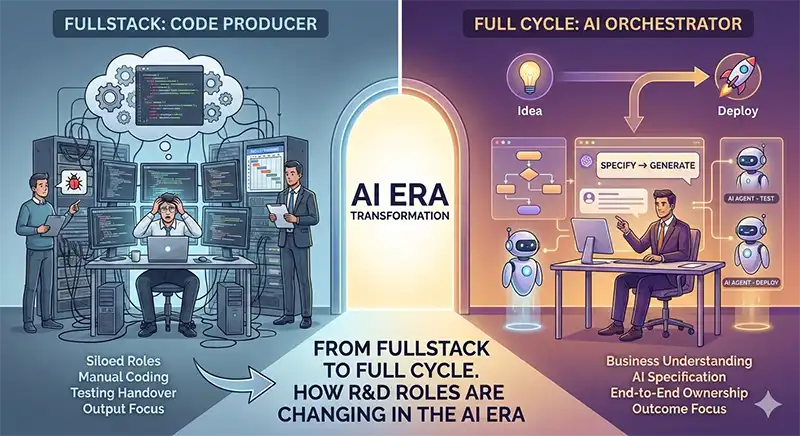
From Fullstack to Full Cycle. How R&D Roles Are Changing in the AI Era.
I always believed that an engineer should be able to do everything. Not just write code. A classic fullstack developer is someone who knows frontend and backend. But for me that was never enough. I wanted to understand DevOps, databases, infrastructure. Everything that helps build a product fast and with quality.
Over time I came to believe that testing should also be in the hands of the engineer who wrote the code. When you hand a feature over to a QA engineer you also hand over the responsibility for quality. The developer starts thinking "someone will check my work, they will catch the bugs". This is the wrong approach. The person who wrote the code should own its quality.
When I started growing in my career and managing teams I realized another important thing. Project management and product management are not something separate from engineering. They are part of the process of building a product. The more an engineer understands the business the better they solve problems. Not technical problems but business problems. And that is exactly what software engineering exists for.
Learning different areas helped me see the bigger picture. Understand why we build what we build. And it made me more effective at every position I held.
AI Made This Not Just Useful But Necessary
Gartner says it directly. The era of developers as "code producers" is ending. In the age of AI developers are becoming "builders" who assemble the right solutions while AI handles the implementation details. The role of the engineer is shifting from writing code to orchestration.
McKinsey confirms this from a different angle. In their research "Agents, Robots, and Us" they describe how employees are moving from performing tasks to managing outcomes. People are moving "above the loop" and managing workflows instead of completing every step themselves. Demand for AI fluency skills has grown 7 times in two years and it is the fastest growing skill in the job market today.
Today one engineer with 3 or 4 AI agents can build in hours what a team used to write in weeks. Coding skills are no longer the main competitive advantage of an engineer.
What has become truly important is this. Understanding how the business works. Being able to talk to a stakeholder and collect requirements. Turning those requirements into a clear specification for an AI agent. Planning the work. Reviewing the result. Deploying the solution to production.
In fact the engineer now does exactly what I always wanted. They run the full cycle of product creation from idea to deploy. Only now with AI agents this has become truly possible.
How This Works in My Team
In my team today we have 2 to 3 roles depending on the project. Each engineer leads 2 to 4 projects at the same time. They work directly with product owners without any middlemen.
Engineers collect requirements for features themselves. They write specifications for AI agents following our AI spec-driven development methodology. They plan their own sprints. They test the code. They deploy the infrastructure. The full cycle is in one pair of hands.
I stay in this process as an architect. But my role has changed. I mostly verify solutions, help with complex situations and train the team. I do not make decisions for the engineers. I help them make decisions on their own.
Product owners also participate less than before. Their main job now is to verify the result. Confirm that what was built actually solves the business problem.
Instead of a big team of 7 to 10 people we work in groups of 2 to 3 people per project. Short work cycles. Minimal communication. Clear goals and results.
What This Means for the Industry
McKinsey says that 75% of existing jobs will need to be redesigned and reskilled by 2030. And this is not about replacing people. It is about rethinking what people do.
Gartner predicts that by 2029 at least 50% of knowledge workers will develop new skills to work with AI agents. This is not the future anymore. This is happening right now.
Companies no longer need narrow specialists who only know one programming language or one framework. They need people who understand the business, can talk to customers and can manage AI agents to solve real problems.
Roles that used to be separate are now merging. The engineer becomes a developer and a tester and a bit of a project manager. The boundaries between roles are disappearing. And this is a good thing.
The future belongs to engineers who think about the business and not just about the code.
Comments